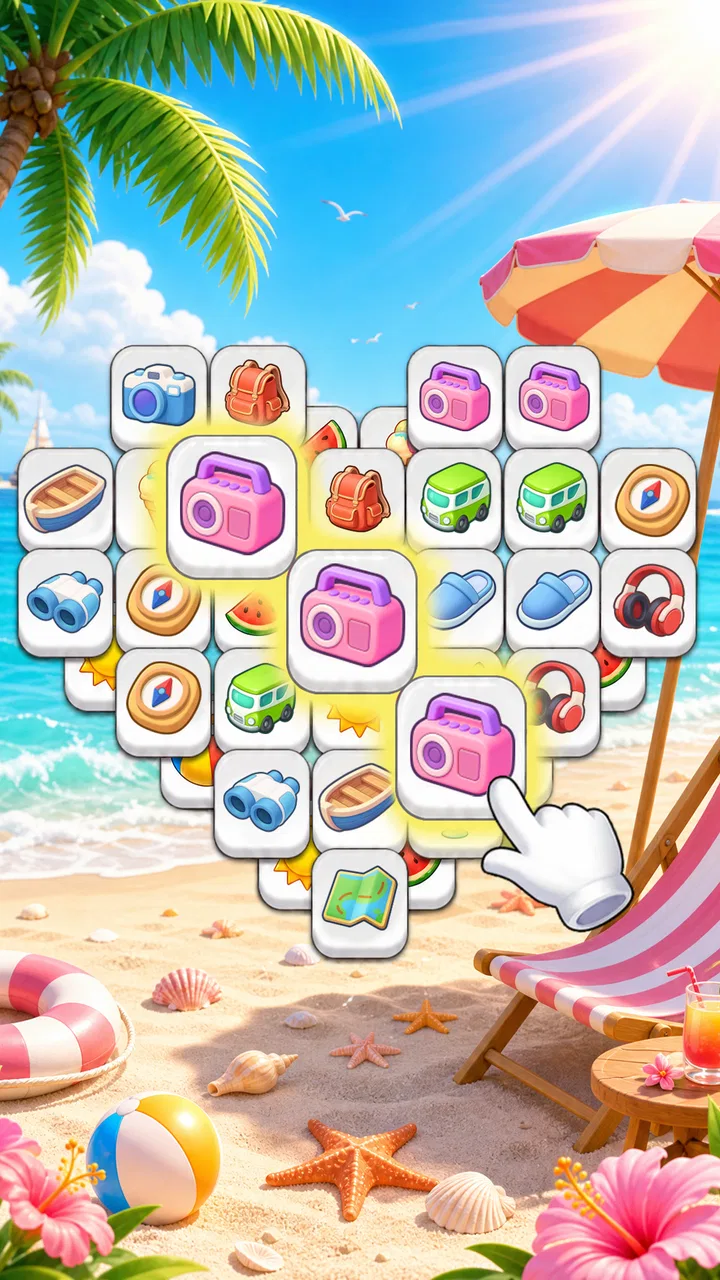
Tile Puzzle Classic
- 5.0
- Rating
- 1.00M
- Installs
- Free
- Price

 Analysis by App-foxy
Tile Puzzle Classic is the kind of casual game I reach for when I want something quiet, familiar, and easy to understand without committing to a long session. Its central idea is simple: arrange tiles, read the board, and keep looking for the move that makes the puzzle fall into place. That simplicity is the main attraction, but it also means the quality of the experience depends heavily on presentation, pacing, and how fairly each challenge communicates what it expects from me.
After spending time with it, my impression is that this is best treated as a focused little puzzle break rather than a deep strategy game. It does not ask me to learn a complicated rule set before I can enjoy it. Instead, the appeal comes from gradually improving my visual reading, avoiding careless moves, and finding a satisfying rhythm between quick decisions and patient observation. The game is free to download, while optional purchases range from $0.99 to $65.99 per item, so I would approach it as a no-cost starting point and decide later whether the extra spending fits my habits.
A calm tile puzzle built around visual clarity
The game comes from SOFISH GAMES and sits firmly in the casual category. That label fits because the basic interaction is approachable even when a particular board becomes demanding. I do not need to understand a fictional universe, memorize a large collection of characters, or follow a lengthy campaign before the puzzle becomes enjoyable. The board itself is the main subject, and every tile contributes to the small visual problem in front of me.
You May Also Like

 Blood Strike: 2.5 Anniversary
Blood Strike’s Loadouts Turn Every Drop Into a Tactical Gamble
A close look at Blood Strike’s custom loadouts: how fast access to signature weapons reshapes its battle royale rhythm, rewards preparation, and narrows the gap between fights.

 Pandora - Music & Podcasts
Pandora’s Music Is Easy to Start, but Harder to Recover
Pandora’s strength is its low-effort path from a seed to a station. Its weak spot is how much confidence it asks you to place in connection, setup, and quiet recovery.

 8 Ball Pool
 Is Built on Rivalries, Rematches, and Routine
A close look at the rivalries, rematches, shared routines, and unanswered safety questions that turn a quick pool match into a persistent mobile community.

 Samsung Music
’s Quiet Strength Is Playing What You Already Own
Its reach comes less from spectacle than from dependable access to a personal library. That simplicity is both the app’s strongest retention engine and its ceiling.

 AccuWeather: Weather Radar
AccuWeather Review: A Quick, Clear Forecast for Everyday Decisions
For everyday plans, the best forecast is the one you can understand quickly. AccuWeather makes rain timing, radar, and local conditions easy to act on, with a few trade-offs.

 Hill Climb Racing
Why Hill Climb Racing Still Turns Crashes Into One More Run
A tiny car, a bumpy hill and one more upgrade: Hill Climb Racing keeps resurfacing because its simple chaos makes every near-miss feel personal.
More From Our News Desk
View All News


My first impression was shaped less by novelty than by accessibility. Tile Puzzle Classic presents a familiar type of challenge in a form that is easy to pick up during a short pause in the day. I can start thinking almost immediately, which makes it suitable for waiting rooms, a commute when I am not driving, or the few minutes before bed. It is also the sort of game I can put down without feeling that I have abandoned a complicated mission.
That convenience has a trade-off. Players who want a strong narrative setting, dramatic progression, or a large collection of distinct mechanics may find the experience restrained. The game’s identity comes from the board and the act of solving it, not from a story wrapped around those actions. I personally prefer that focus when I want mental quiet, but I would not choose it as my main game if I needed constant surprises or a sense of adventure outside the puzzle itself.
The audience reach is broad: the content rating is Everyone, and the game runs on Android versions starting with Android nine. Its listing shows more than a million installs and a perfect five-point average from roughly four thousand nine hundred ratings, which suggests that the straightforward format has found a receptive audience. I still think the numbers should be read alongside personal taste. A highly accessible puzzle can be widely liked and still feel too gentle or repetitive for someone who prefers action, competition, or complex planning.
The visual language does most of the explaining
In a tile game, art direction is not decoration placed around the mechanics; it is part of the instruction system. I need to distinguish shapes, colors, edges, and relationships quickly. When those elements are presented cleanly, the board feels inviting. When they become visually noisy, even a fair puzzle can feel frustrating because I am spending effort decoding the display rather than solving the problem.
Tile Puzzle Classic works best when I treat its visual arrangement as a language. A cluster of matching or related pieces gives me a reason to inspect one area before another. Empty spaces become useful information instead of dead space. The board encourages me to scan broadly first, then narrow my attention to the move that appears most constrained. That habit is more valuable than rushing toward the first obvious placement.
One useful technique I developed was to stop staring at individual tiles and read the board in groups. I look for corners, isolated gaps, and areas where only one shape seems likely to fit. This reduces the feeling of random trial and error. It also makes the game more relaxing because each move follows a small visual argument: this piece belongs here because it preserves the options around it.
Another practical tip is to pause after a successful placement instead of immediately making the next move. The board often becomes easier to read once one obstruction has disappeared. I found that taking a brief reset helped me notice secondary patterns that were hidden by the earlier arrangement. This is especially useful for players who tend to make mistakes through speed rather than through a lack of understanding.
The art direction also affects how long I can comfortably play. A clean, restrained board supports concentration, while an overly decorative design would compete with the task. For me, the strongest mood comes from the balance between a pleasant appearance and enough contrast to keep the puzzle legible. The visual presentation should invite me in, then get out of the way while I think.
Sound and pacing keep the mood gentle
The atmosphere of a casual puzzle is often created through restraint. I do not want every move to feel like a major event, and I do not want the game to pressure me into treating a small mistake as a disaster. Tile Puzzle Classic is most appealing when its pacing leaves room for observation. The board gives me time to inspect possibilities, make a choice, and see whether that choice improves the position.
I think of the sound design as supporting this rhythm rather than trying to dominate it. In a game built around repeated tile interactions, audio feedback has a practical job: it should make a placement feel acknowledged without turning every action into noise. That distinction matters during longer sessions. If the sound layer remains subordinate to the board, I can stay focused on the visual flow instead of waiting for a dramatic reward after every move.
This gentle pacing makes the game a good fit for a daily decompression routine. I can play a few boards after work while my attention gradually shifts away from unfinished tasks. The act of sorting possibilities gives my mind something specific to do, but the stakes remain low enough that I do not carry the tension into the rest of the evening. I would also use it during a short break when I want more engagement than scrolling but less intensity than an action game.
There is a limitation here for players who need a strong sense of urgency. A calm tempo can feel slow if you prefer countdowns, rapid combos, or competitive pressure. I would choose a timed puzzle or a more energetic arcade title when I want my reflexes tested. Tile Puzzle Classic is better when I want the pleasure of finding order, not the adrenaline of surviving a sequence of fast demands.
My advice is to play it in short, intentional sessions rather than expecting it to provide a full evening of escalating excitement. The mood works because the game does not constantly shout for attention. That is a strength when I am tired, but it can become a weakness if I am looking for a dramatic change of pace.
Where the mechanics fit—and where they do not
The mechanical appeal comes from the relationship between recognition and restraint. I am not merely searching for a move that works immediately; I am trying to avoid creating a worse position a few steps later. That gives the simple tile format a modest layer of planning. The best move is often the one that keeps several future options open, not the one that produces the quickest visible result.
This is where the game becomes more satisfying than a purely automatic matching exercise. I can build a small personal workflow: scan the whole board, identify the least flexible area, test the move that resolves it, and then reassess instead of following my original plan blindly. That approach is useful because puzzle boards can change in value after each placement. A move that looked secondary may become urgent once the surrounding space is reorganized.
I also learned to treat hesitation as information. If I cannot decide between two placements, I ask which one blocks fewer possibilities. This is a more reliable question than asking which move looks most attractive. It turns uncertainty into a comparison of consequences and helps me play with intention. For a casual game, that is a surprisingly useful mental exercise, especially for anyone who enjoys visual sorting or spatial reasoning.
The main friction is repetition. Because the core activity remains tile arrangement, the experience may not provide enough mechanical variety for players who need new systems to stay interested. I would not describe that as a flaw in the basic design; it is a boundary of the format. The game succeeds by refining one activity, so anyone seeking elaborate upgrades, character abilities, or changing objectives should look elsewhere.
Another consideration is spending. The game is free, but in-app items are available, with individual prices reaching $65.99. I would be careful here and decide in advance whether I want to keep the experience entirely free or set a personal limit. A relaxed puzzle can make small purchases feel harmless in the moment, particularly when I am stuck and want an easier path. My own preference is to treat optional buying as a deliberate choice rather than part of the solving routine.
The current version is 1.0.40, and that is useful to check before installing because compatibility and available behavior can change over time. I would also make sure the device meets the Android requirement before expecting a smooth start. On iOS, I would verify the current store compatibility separately before downloading, since the Android requirement applies specifically to the Android release.
Who will enjoy the everyday experience
I would recommend this game to someone who likes puzzles that explain themselves through the board. It suits players who enjoy gradually improving their eye for patterns, people who want a low-pressure distraction, and anyone who prefers a game that can be stopped without losing the whole point of a session. It is also a reasonable choice for families looking for an Everyone-rated title with a simple premise that does not depend on a large amount of reading.
A realistic use case is a ten-minute break between errands. I might open it while waiting for a pickup, solve a few arrangements, and close it when my turn arrives. The game does not require me to remember a complicated plot or rebuild a long chain of progress in my head. That makes it more convenient than many role-playing or strategy alternatives, where a short interruption can leave me feeling that I have barely started.
It can also work as a concentration warm-up. Before writing, studying, or organizing a busy schedule, I could use a brief puzzle session to shift from scattered attention toward deliberate observation. I would keep that session short, though. The benefit comes from focusing on a contained problem; playing for too long may simply replace one form of procrastination with another.
I would suggest skipping it if your priority is competitive ranking, a rich story, fast reaction tests, or a constantly changing rule set. Traditional match games may be a better fit if you want chain reactions and colorful bursts of feedback. Logic games with multi-step deduction may serve you better if you want deeper planning. Tile Puzzle Classic occupies a quieter middle ground: more thoughtful than a purely passive distraction, but less ambitious than a full puzzle campaign.
My verdict on the atmosphere and lasting appeal
What holds the experience together is the agreement between its visual language, sound, and pacing. The board asks me to slow down and notice relationships. The audio, when kept in its supporting role, reinforces the feeling that each placement has landed cleanly. The unhurried rhythm gives the puzzle room to breathe. None of those elements would matter much if the mechanics were confusing, but together they create a coherent mood for short, focused play.
I especially appreciate that the game rewards a better process rather than just faster tapping. Scanning constrained spaces, preserving future options, and reassessing after each meaningful placement are habits that make the simple format feel more deliberate. Those are the details I would mention to a friend, because they change the experience from random tile handling into a small exercise in visual planning.
At the same time, I would keep expectations realistic. This is not the game I would install for a sweeping world, a dramatic soundtrack, or a major sense of progression. Its appeal is narrower and more honest: it gives me a calm board, a clear task, and a reason to concentrate for a while. The free entry point makes it easy to try, while the optional purchase range means I would pay attention to my spending choices rather than assume every useful convenience is free.
With a perfect five-point average from about four thousand nine hundred ratings and over a million installs, Tile Puzzle Classic has clearly connected with many casual puzzle players. My own recommendation is conditional but positive: try it if you want a quiet tile-based game that fits naturally into small breaks and rewards patient observation. If your ideal game needs constant novelty or pressure, choose something more dynamic. For everyone else, this is a modest, approachable way to turn a few spare minutes into a focused and pleasantly orderly challenge.
FAQs for Tile Puzzle Classic
01What is Tile Puzzle Classic and how does it work?
Tile Puzzle Classic is a mobile game app designed to provide a relaxing and engaging puzzle-solving experience. Players are tasked with rearranging scrambled tiles to form a complete picture. The game offers various categories and difficulty levels, making it suitable for all ages. Its intuitive interface allows players to simply tap and slide tiles to solve puzzles.
02Is Tile Puzzle Classic available for both Android and iOS devices?
Yes, Tile Puzzle Classic is available for download on both Android and iOS platforms. Users can find it on the Google Play Store for Android devices and the Apple App Store for iOS devices. This ensures a wide accessibility for users regardless of their preferred operating system.
03Are there in-app purchases in Tile Puzzle Classic?
Tile Puzzle Classic offers in-app purchases, primarily for additional puzzle packs and to remove advertisements. While the base game is free and includes a variety of puzzles, purchasing additional content can enhance the gaming experience by providing more themes and levels. Users can decide based on their preference and budget.
04Does Tile Puzzle Classic require an internet connection to play?
Tile Puzzle Classic can be played offline, making it a great option for users who want to enjoy the game without needing a constant internet connection. However, certain features, such as downloading new puzzle packs or syncing progress across devices, may require an internet connection.
05What age group is Tile Puzzle Classic suitable for?
Tile Puzzle Classic is suitable for all age groups, offering various difficulty levels that cater to both children and adults. The easy levels are perfect for younger players, while more challenging puzzles can engage older users. The game’s family-friendly design makes it a versatile choice for players of all ages.
Pros
- Intuitive interface makes gameplay smooth.
- Variety of puzzles keeps users engaged.
- Offline mode available for on-the-go play.
- Regular updates with new puzzle packs.
- Easy difficulty adjustment for all skill levels.
Cons
- Ads can be intrusive during gameplay.
- Limited hints without in-app purchases.
- Graphics are basic
- lack visual flair.
- No multiplayer or community features.
- Sound effects can become repetitive.

Tile Puzzle Classic
Gallery